Click Here for Printable Version
The equity bull market remains intact despite the worrying rise in global bond yields. Why do high bond yields matter? Firstly, in business, company directors make investment decisions based on the likely profit compared to how much that capital would cost, i.e. a bank loan or bond issuance. Historically, an 8% profit return is the absolute minimum required for a business investment to take place. With long-term bond yields now approaching 6% the margin between the two numbers is narrowing, making more investment unviable. No investment means no growth. For governments who are primarily investing in green energy projects, where the returns are lower, many projects have now become unfeasible. Secondly, for the markets, there is also a direct relationship between bond yields and returns. A share price, according to classic investment mathematics (dividend discount model), is the discounted value of future cash flows (dividends), the discount rate applied in the calculation is the risk-free rate of return i.e. the bond yield. This is why pension fund transfer values were high when gilt yields were low and are now significantly lower now yields are at 20-year highs. In simple terms, before the recent rise in bond yields, the S&P 500 should have been valued at a P/E ratio of 19, now with the higher bond yields, it should be valued lower at a P/E ratio of 16, currently about 18
ahead of what should be a strong earning season. Why are bonds falling in value, there is a strong correlation between oil price movements and bond prices.
Oil and Bond Yields
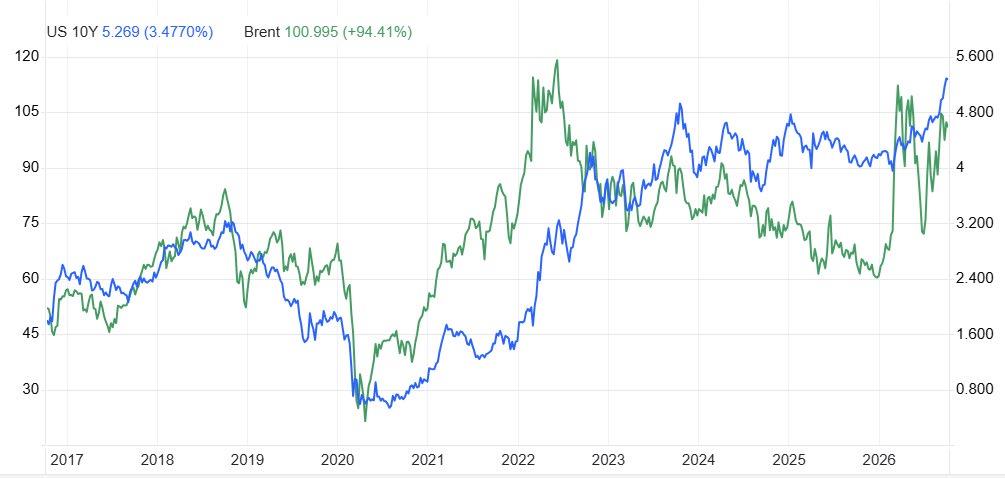
This is most important chart for the global markets at present. The Green line is Brent Crude Oil; Blue line is the yield of the US Treasury 10-year bond. This is the bond that sets interest rates globally, every government bond and thus bank loan or savings account is set relative to the yield on this bond. Presently, the trend for the bond is set by the oil price. This is logical, oil via LNG sets the price of electricity still (despite heavy investment in green energy) and will do so for years yet. It also sets the cost of transport
through petrol and diesel prices and food prices through fertiliser costs. So, oil goes up, so does inflation and thus so should interest rates.
Oil
The difficult decision for investors is where the oil price is headed. If the Straits of Hormuz reopen, then the flow of crude oil, fertiliser, diesel, and liquefied natural gas should come flooding onto the world markets, at once reversing global inflation trends and allowing central banks to stop raising interest rates. Interestingly, as Javier Blas of Bloomberg notes, the flow of just crude oil through the Straits of Hormuz has returned to ‘normal.’ The Straits presently is closed by the US Navy seeking to economically isolate Iran. Crude oil exports from the Gulf States via the waterway, plus bypass routes, have risen to about 80% of prewar levels. Iran, meanwhile, has seen its own oil exports plunge to zero. Gulf crude shipments have now reached a six-month high of 14 million barrels per day, according to Vortexa, an energy markets analytics firm. Other tanker trackers, oil traders, and government officials have arrived at similar figures. Yet Brent Crude remains stubbornly above $100 per barrel. Markets continue to fear Iran which now faces a limited number of choices: negotiate or escalate. With few obvious signs of negotiation, oil traders must price in the risk that they will escalate. Iran is experiencing an economic crisis with inflation at 88% according to official numbers and unofficially perhaps as high as 130%. The US economic pain comes from record-high diesel prices ahead of the Thanksgiving and Christmas holidays, which will stoke inflation, maybe only temporarily, but the Federal Reserve Bank can’t be sure of that. It’s now a game of ‘who blinks first.’ Iran has leverage ahead of the US mid-terms, afterwards Trump probably won’t care!
Shipments of gasoline, diesel and jet fuel, however, remain at 50% of normal. Why? Moving refined products is more expensive (and dangerous) than moving crude. Chartering a super tanker to go through the Straits for crude oil now costs an average $30 million per crossing, equal to roughly $15 per barrel. To make the convoys work on pure economics, Gulf nations must discount their crude, at times by $20 to $30 below market levels. The economics of risking refined products just doesn’t work. Trump still needs the Straits open fully.
Earnings Growth Key Market Driver
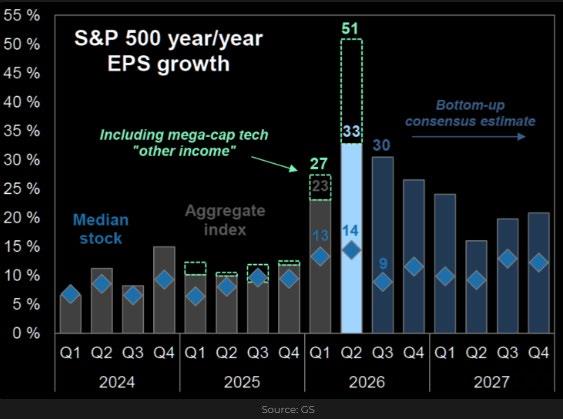
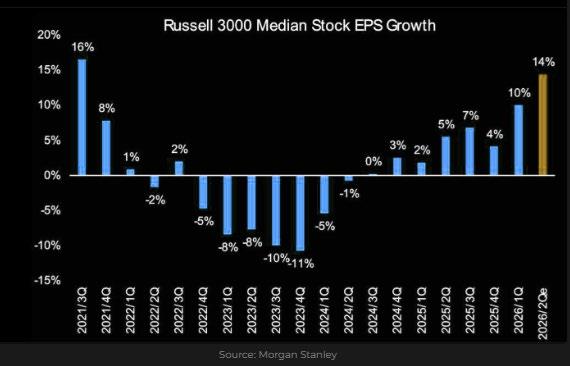
With the interest rate market driver now officially turned negative, this Bull market is now wholly reliant on earnings growth to keep the trend going. Here at least the trend remains very positive. Excluding the mega-cap tech, year on year earnings growth rate from ‘the rest’ has grown impressively to 33% in Q2 with another 30% in Q3 expected. Energy and banking are the big non-tech drivers, but as the second chart shows the average (median) company is doing nicely as well. If we then add the huge (but still suspicious) growth of AI related tech companies, then the picture becomes even more impressive. It needs to be any slowdown without a deal on the Straits of Hormuz would leave the equity markets very vulnerable.
Markets
The Bond market stress is rising with US 30-year Fixed Mortgage rates are now above 7%. Markets also fear an escalation in the Iran conflict ahead of the US mid-term elections. Inflation risks becoming embedded as diesel and food prices rise ahead of the key US Thanksgiving and Christmas retailing period. However, markets are more than capable of looking through temporary price shocks, if they appear temporary. In markets, it is always more profitable to be optimistic than pessimistic and there does remain a window for an Iranian deal. In the UK, October 28th sees the first “Burnham Budget”. Lessons do seem to have been learned from the Starmer/Reeves Budget period and its very damaging tax hike speculation which so far has been avoided. It is clear, though, that taxes will have to rise. The best route to raise the most money in the least economically damaging way would be to raise income tax rates. Gilts would like that, but whether it’s politically possible is a different matter. Gilt markets would not like ad-hoc tax changes to Capital Gains Tax, Mansion taxes, etc., where cash flow is uncertain and may even be negative. France’s current Budget crisis is a timely warning to John Healey.